Featured

ESoup 4 Life with Sandy Hunt

I hate writing bios. That’s the first thing you need to know about me. And the second thing you need to know is that I have had a personal mission statement for at least 25 years.

That mission statement is sort of like a buoy in the water that marks safe passage. When confronted with an opportunity, or a dilemma, you can hold it up to the mission statement to see if it fits your purpose.

My mission statement is three-fold and covers what is most important in my life. They were developed prayerfully and thoughtfully based on my passions in life.

  • To live a life that honors God. That is #1.
  • To be the type of wife and companion that my husband needs. That is #2.
  • To help others reach their highest potential both personally and spiritually. That is #3.

And that brings us to ESoup – an eclectic mix of simple, optimal, useful principles for every day life.

There are keys to living a life that honors God. Some simple things really, but ones we don’t take the time to incorporate into our day. I’ll share one with you right now – how often do you think about what you are thinking about? Your thoughts are critical to your success on all levels. We will talk about bringing those thought captive. Learning how to do that took me from being a shy, reticent young woman to a leader in my field.

And I had to learn how to be in a long-term relationship and become the type of wife and companion that my husband needs. Ours is truly a love story. We have been together, as of this writing, for 45 years. We were young parents and I think the first in our circle of friends to have children. Relationships of any kind can be difficult and marriage especially requires the ability to learn to love someone “warts and all”.

Which brings us to now – helping others reach their highest potential both personally and spiritually. This is all about you and how you can take some of things that have helped me to help yourself. In sharing this journey, and these principles for life, my goal is to help you navigate the choppy waters. And along the way, experience some smooth sailing in your own life!

“The most common way people give up their power is by thinking they don’t have any.” – Alice Walker

When the Heart Leads and the Mind Follows

Person at sunrise crossroads, truth vs comfort

“What the human being is best at doing is interpreting all new information so that their prior conclusions remain intact.” — Warren Buffett

It’s a striking thought.

We like to believe we are logical. Thoughtful. Open-minded. Truth-seeking.
But in reality, much of what we do is something else entirely—we protect what we already believe.

Our minds don’t naturally search for truth.
They search for agreement.

We filter new information through old conclusions. We accept what aligns and quietly dismiss what doesn’t. Not out of malice… but out of comfort. It feels safer to be right than to be changed.

And then there’s the heart.

“The heart is deceitful above all things and beyond cure. Who can understand it?” — Bible (Jeremiah 17:9)

That verse can feel harsh at first glance. But maybe it’s not meant to condemn us—maybe it’s meant to wake us up.

Because the heart doesn’t just feel… it convinces.
It justifies.
It tells stories that make our current beliefs feel true, even when they may not be.

So now we have both working together—
a heart that persuades, and a mind that defends.

Left unchecked, that combination doesn’t lead us toward truth.
It leads us deeper into ourselves.

Which is why this instruction becomes so powerful:

“Be transformed by the renewing of your mind.” — Bible (Romans 12:2)

Transformation doesn’t happen automatically.
It requires intention.

It requires us to pause in the middle of our certainty and ask:
What if I’m wrong?
What if there’s more to see?

Renewing the mind means creating space between what we feel and what is true. It means inviting God into our thinking—not just our believing.

Because truth doesn’t always feel comfortable.
And growth rarely feels familiar.

But there is something deeply freeing about surrendering the need to be right…
and choosing instead to be transformed.

Today is an opportunity.

To notice your thoughts.
To question your assumptions.
To soften your certainty just enough to let truth in.

Not everything we think is truth.
Not everything we feel is right.

But with a renewed mind, we can begin to see more clearly.

And that changes everything.


✨ Reflection

Where in your life might you be holding onto a belief simply because it feels comfortable?


✨ Closing

Walking in purpose, thinking in synergy.

Micro-Habit #3

For a long time, I told myself that I did my best work under pressure.

It sounded responsible.
It sounded productive.
It even sounded a little impressive.

But if I’m honest, most of the time it was just a spiritual-sounding way of saying:

“I’m procrastinating.”

Not because I didn’t care.
Not because I was lazy.
But because some parts of my work simply weren’t as fun, as stimulating, or as energizing as others.

Every vocation—even the ones we love—has responsibilities like that.

Paperwork.
Follow-ups.
Planning.
Administrative details.
Hard conversations.
Uncomfortable decisions.

Those were the areas where I delayed.

I waited for motivation.
I waited for the right mood.
I waited for “more time.”

And usually… all the time I was procrastinating, I was also feeling the pressure and the stress and the weight of unfinished business.


When Pressure Becomes an Excuse

Somewhere along the way, I noticed a pattern.

I would delay a task until the deadline was close.
Then I would rush, scramble, and stress.
And when I finished, I would say,

“See? I work best under pressure.”

But the truth was:

Pressure didn’t make me better.
It just made me tired.

It didn’t improve my work.
It only increased my anxiety.

And it certainly didn’t honor the peace God desires for His children.


The Two Words That Changed Everything

Then I learned a simple phrase.

Just two words.

Two words that quietly transformed my productivity, my mindset, and my peace.

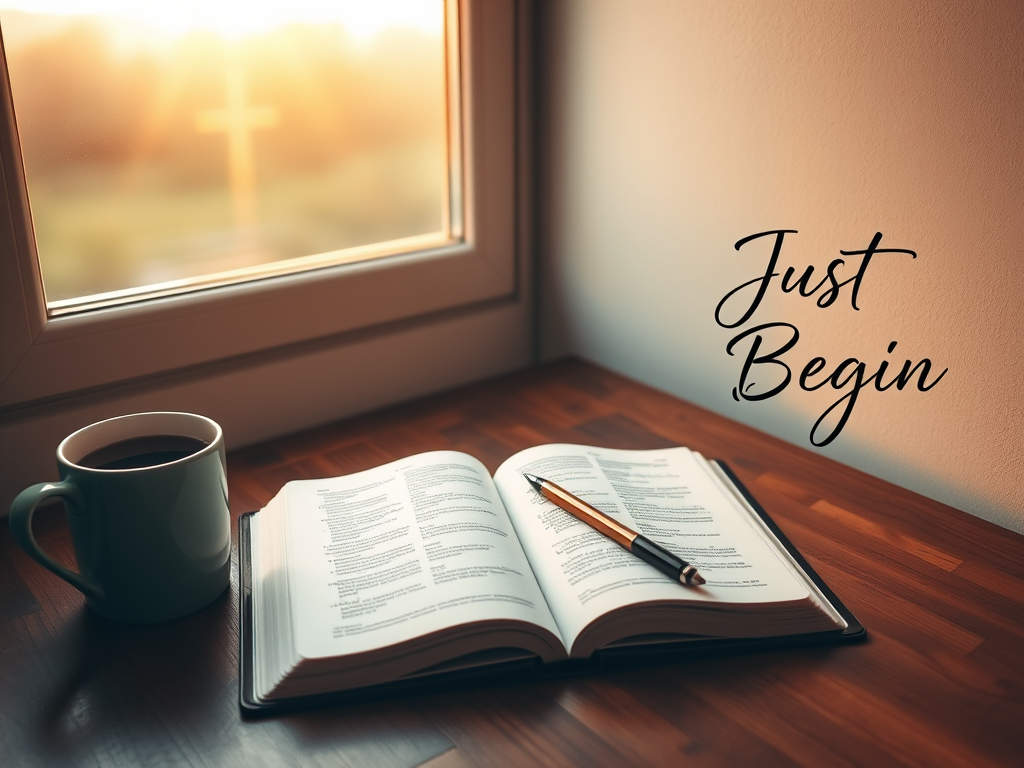
Just begin.

That’s it.

Not “finish it all.”
Not “do it perfectly.”
Not “feel inspired first.”

Just begin.


Why “Just Begin” Works

When you begin something, something powerful happens.

Fear loses its voice.
Overwhelm starts to shrink.
Confusion begins to clear.
Momentum starts to grow.

Motivation doesn’t usually come before action.

It comes after.

We think we need to feel ready.

But readiness is often the result of obedience.

When you take the first small step, God meets you there.


How I Practice This Micro-Habit

Now, when I notice myself avoiding a task, I pause and ask:

“Why am I delaying this?”

And then I say out loud:

“Just begin.”

Sometimes that looks like:

  • Opening the email and typing one sentence
  • Filling out one line of paperwork
  • Writing one paragraph
  • Making one phone call
  • Creating one outline point

I often set a five-minute timer.

Five minutes feels manageable.
Five minutes feels safe.
Five minutes feels possible.

And more often than not, five minutes turns into thirty.

Because once you start, you’re no longer fighting resistance.

You’re moving forward.


Procrastination Is Often Fear in Disguise

Over time, I realized that procrastination isn’t usually about time.

It’s about emotion.

Fear of doing it wrong.
Fear of it taking too long.
Fear of not knowing where to start.
Fear of feeling inadequate.

So we delay.

We distract ourselves.
We reorganize.
We “get ready.”

But rarely do we begin.

“Just begin” interrupts that cycle.

It replaces fear with faith.


A Spiritual Perspective

There is something deeply spiritual about starting.

Scripture tells us:

“The steps of a good person are ordered by the Lord.”

Notice it says steps.

Not sitting.
Not waiting.
Not overthinking.

Steps.

God orders movement.

When we begin, we are saying:

“Lord, I trust You with this process.”

“I trust You to guide me as I go.”

“I trust You to meet me in the middle.”

Faith is rarely about having everything figured out.

It’s about taking the next right step.


Small Starts Lead to Big Faithfulness

Some of the most meaningful progress in my life has come from very small beginnings.

One email.
One decision.
One page.
One prayer.
One phone call.

Over time, those small beginnings add up.

They build discipline.
They build confidence.
They build integrity.

And they create peace.

Because there is great freedom in knowing:

“I did what I was supposed to do today.”


My Invitation to You

If there is something you’ve been delaying…

A project.
A conversation.
A decision.
A responsibility.

I invite you to try this with me.

Right now.

Don’t finish it.
Don’t perfect it.
Don’t overthink it.

Just begin.

Take one small step.

And trust God with the rest.


Final Thought

You don’t need more motivation.
You don’t need more time.
You don’t need perfect conditions.

You need two words:

Just begin.

Walking in purpose.
Thinking in synergy. ✨

Micro Habit #2: Deal With It While It’s in Your Hands

I get asked a lot how I manage to get so much done.

The short answer?
I don’t let things linger.

In my last post, I shared how starting each morning by checking my calendar sets my intention for the day. That one minute grounds me in what actually matters.

The next micro habit builds on that foundation:

Deal with things as they come across your desk.

Not later. Not “when I have time.”
When they arrive.

Why This Matters

Every unopened email, unanswered text, or unopened envelope quietly takes up mental space. Even when we’re not actively thinking about it, our brain knows it’s there—and that low-grade tension adds up.

This habit isn’t about being reactive.
It’s about being decisive.

Email: Touch It Once (If Possible)

I check my email once a day, usually mid-morning. Anything that comes in after that waits until the next day—unless I’m expecting something specific.

When I open an email, I make a decision immediately:

  • If it’s an invitation to a meeting or webinar
    I register or reply right then and post it to my calendar. I don’t save it for later.
  • If it requires information I don’t yet have
    I use Gmail’s Boomerang feature and schedule it to return to my inbox at a time when I know I’ll have what I need.

No mental notes.
No sticky reminders.
No inbox clutter pretending to be a to-do list.

Snail Mail: Same Rules Apply

Physical mail gets the same treatment:

  • Read it.
  • Toss it.
  • Answer it.

If it’s a bill that requires payment, I don’t stop my workflow to pay it immediately—but I do decide what to do with it.

I pay bills twice a month: the 15th and the end of the month. Anything due goes into a designated file until that time. Once it’s filed, my mind is free from it.

The key isn’t doing everything instantly.
The key is deciding instantly.

Text Messages: The Fastest Path to Me

Text messages are actually the easiest—and often the best—way to reach me.

If I see it, I answer it.
No inbox triage. No delay.

That responsiveness isn’t accidental; it’s the byproduct of not letting communication pile up elsewhere.

The Real Secret Isn’t Speed—It’s Closure

This micro habit works because it creates closure.

Every message, email, or envelope asks one simple question:
“What am I going to do with this?”

When you answer that question immediately, you remove friction from your day and clarity replaces clutter.

It’s a small habit.
But repeated daily, it quietly multiplies your effectiveness.

Walking in purpose, thinking in synergy.

How Do You See Yourself?

We all like to think of ourselves as the “good ones.”
Kind-hearted. Well-intentioned. Fair. Reasonable. Doing the best we can.

And most of the time, that’s true.
But there’s another truth we don’t always like to examine: we all have blind spots about ourselves. Those behaviors, motivations, or attitudes that we simply cannot see clearly because we’re standing too close. Because we have told ourselves that our actions are pure.

It’s a strange thing—the way the human mind works. We are both the main character in our lives and the most deceitful interpretor.

The Version of Ourselves We SEE… and the Version Others EXPERIENCE

If you’ve ever replayed a conversation in your head and thought, “I didn’t mean it that way,” you’ve already brushed up against the idea of blind spots. Sometimes it is a matter of clarity – we know what we meant but failed to explain it adequately. Other times, we justify our actions or our words because we haven’t truthfully examined our own motive.

Intent is internal.
Impact is external.

We tend to judge ourselves by our intentions, but others judge us by our actions. And somewhere inside that gap is where misunderstandings, missteps, and sometimes hurt feelings take root. Not because we’re bad people. But because we didn’t look deeply enough.

We saw ourselves in our best light—the most generous interpretation and the most gracious version of the ideal motive.

Meanwhile, someone else may have experienced something entirely different.

Our Inner “Best Light” Filter

There’s a built-in psychological trick humans play on themselves:
we assume we’re acting for the right reasons because we want to believe we’re good. We filter our own motives through the lens of what we hope they are—
not always what they actually are. And we really need to look deeply to discover our true motives and intentions.

  • “I’m just being honest.” → But is it honesty, or is it impatience?
  • “I’m only trying to help.” → Or are you trying to control the outcome?
  • “I’m standing my ground.” → Or are you avoiding vulnerability?
  • “I’m doing what’s best for them.” → Or is it what’s safest for you?

Most of the time, it’s a blend and it’s complicated. We can have pure intentions tangled up with ego, fear, habit, and pride.

‘Unto the Pure, All Things Are Pure’ — But… Are We Pure?

This scripture has a beautiful simplicity.
If your heart is honest, you’re not looking for deceit.
If your motives are clean, you aren’t plotting harm.
If your spirit is aligned, you see the world through that clarity.

But this verse doesn’t assume perfection.
It’s an invitation to examine:
Are we truly operating out of purity… or out of something else?

Purity is clarity.
Purity is self-awareness.
Purity is the willingness to see ourselves without the flattering filters.

It doesn’t mean we’re flawless. It means we’re willing to look. And willing to admit our imperfections and to change, or pivot as necessary.

Why Blind Spots Matter

Blind spots aren’t inherently bad. They’re human.
But when we don’t acknowledge they exist, they affect our relationships, and our ability to lead. They affect our intent and the outcome of our actions.

And often, they keep us from growing because we can’t heal what we won’t see.

Three Practical Ways to Reveal Your Blind Spots

1. Ask yourself the uncomfortable “why.” Twice.

Once you think you know your motive, ask again.
The second answer is usually closer to the truth.

2. Seek perspective gently, from people who love you enough to be honest

People who want the best for you. You don’t have to agree with everything they say, but their vantage point matters.

3. Rethink your interpretation of your own behavior.

Before justifying something you did or said, pause.
Is the story you’re telling yourself the whole story… or just the comfortable part?

The Good News: Blind Spots Shrink with Self-Reflection

Seeing ourselves clearly isn’t a one-time thing.
It’s a practice—a spiritual and emotional discipline that gets easier the more we do it.

When we’re willing to step back, invite clarity, and examine our motives with honesty, we move closer to that scripture:

Unto the pure, all things are pure.

Not because we’re perfect, but because we’re continually choosing truth over comfort, humility over ego, and growth over self-protection.

And when we do that, not only do we see ourselves more clearly—
others begin to see us through that clarity as well.

Walking in purpose, thinking in synergy.

How One Minute a Day Grounds My Week

There are seasons in life where the big things feel overwhelming — big goals, big transitions, big responsibilities. But lately, I’ve been realizing something simple: it’s not the big things that hold me together.

It’s the small ones.

The little rhythms.
The few seconds of intention.
The tiny pauses where I check back in with myself and with God.

For me, one of those small-but-mighty habits is something so simple it almost feels silly to mention:
spending one minute each morning looking at my calendar.

But that single minute?
It grounds my entire week.


What Is a Purpose-Driven Micro-Habit?

A micro-habit is just a tiny action you repeat consistently.
Not a major overhaul.
Not a full routine.
Just one, small, intentional step.

Purpose-driven micro-habits are the ones that bring you back to:

  • who you are,
  • what matters,
  • and where God is leading you.

They’re not about productivity — they’re about alignment.
They help create space for peace, focus, and spiritual clarity.

And they don’t require a whole morning routine or a complicated system.
Often, they’re barely a minute long.


My Calendar System: More Than Organization

I’m a calendar person — always have been.
I use a weekly desktop calendar where I can physically see my week spread out, and I also keep everything in my phone where reminders can find me.

It’s a solid system.
But systems aren’t what change us.

The micro-action inside the system is what gives it meaning.

Over the years, I’ve realized it’s not the calendars themselves that ground me.
It’s the one tiny moment where I check in with them — and with myself — each morning.


🌞 The 60-Second Daily Preview

Here’s my micro-habit, scaled down to its simplest form:

Every morning, I take one minute to glance at my day.

Not plan it.
Not control it.
Not try to do everything at once.
Just see it.

Sixty seconds.
One small breath.
A soft orientation.

During that minute, I ask:

  • What matters today?
  • Where is my energy needed?
  • What can wait?
  • And quietly… “God, guide my steps.”

It’s amazing how one tiny moment of clarity can calm your whole day.
It takes the pressure off.
It turns chaos into intention.
It gives God room to speak into the little things before the day speaks loudly on its own.


Why This Micro-Habit Works (Spiritually + Practically)

There’s a scripture that has always spoken to me:

“One who is faithful in very little will also be faithful in much.”
Luke 16:10a

This is the heartbeat of micro-habits.

God doesn’t always start with the big assignments.
Often, He starts in the small spaces — the quiet, barely-noticeable moments where we choose intention over autopilot.

Being faithful in very little looks like:

  • one minute of clarity,
  • one single prayer,
  • one small act of alignment.

When we honor the small, God trusts us with the larger things.
And the practical benefit is just as powerful:

  • You feel calmer.
  • You feel prepared.
  • You feel connected to purpose.
  • You show up with clarity instead of rushing in blind.

One minute becomes the anchor for the other 1,439 minutes of your day.


The Synergy of God in Small Rhythms

I’ve always believed that God works through synergy — the beautiful connection between our small actions and His larger plans. We bring the little, and He multiplies it into much.

This one-minute habit reminds me of that synergy every single day.

Especially after seasons where I’ve felt off-center or uncertain, this tiny ritual has helped me reconnect. It’s not dramatic or flashy. It’s just consistent. It’s faithful. And God meets me there.

We think purpose lives in the big decisions, but often, purpose grows in the small daily choices we make with intention.


A Gentle Invitation

If you’re feeling scattered, overwhelmed, or just pulled in too many directions, try choosing one micro-habit this week.

Not a whole routine.
Not a major life overhaul.
Just one small, steady action.

Here are a few ideas:

  • One minute with your calendar
  • One line of gratitude
  • One verse of scripture
  • One deep breath before you start your car
  • One encouraging text to someone God puts on your heart

Small things matter more than we think.
Sometimes they matter the most.


Walking in purpose, thinking in synergy.

Finding My Center Again: What Losing Taught Me About Emotional Agility

Eighteen months ago, I went through something that knocked me off balance in a way I didn’t expect. After twenty years of serving my community — building projects, strengthening neighborhoods, bringing new ideas to life — I ran for re-election as Mayor of New Martinsville. I poured my heart, experience, and vision into that race.

And I lost.

Now, on paper, it was a simple outcome. Someone wins, someone doesn’t. But emotionally? It hit differently. This wasn’t just a professional disappointment. It shook something deeper — my sense of identity, purpose, and connection to the work I’d spent two decades doing.

For several months afterwards, I felt… off-center. Not broken. Not defeated. Just not quite myself.


When Your Identity Shifts, Even Slightly, You Feel It Everywhere

People sometimes think loss — political or otherwise — is just an external event. But when you’ve spent years showing up for others, investing your time, energy, and heart into a place you love, the outcome feels personal. It touches who you believe yourself to be.

That’s what happened to me.

After the election, my usual energy was muted. My outgoing, engaging, roll-up-my-sleeves self was still there somewhere, just operating at half-volume. I found myself asking quiet questions like:

“Who am I when the role I hoped for doesn’t materialize?”
“What stays true about me when a title slips away?”
“Where does my purpose live now?”

Did I even want to continue in public service?

Those questions weren’t dramatic — they were honest. And honesty is where healing lives.


I Didn’t Bounce Back. I Rebuilt.

Looking back now, I can see that I didn’t just “get over it.” That’s not how real emotional recovery works. I moved through the experience slowly, thoughtfully, and compassionately.

I let myself feel disappointed without rushing it away.
I reminded myself that a title is a role — not my identity.
I gave myself grace on the days when I felt less like “me” and more like a muted version of myself.

And then, I started doing what has always brought me home:

  • Conversations with people I care about
  • Re-engaging in community projects
  • Pouring myself back into the work of helping others
  • Small daily habits that reconnect me with purpose

Not because I was forcing a comeback… but because those things naturally help me reconnect with my center.


The Turning Point Was Quiet

There wasn’t a dramatic moment where I suddenly felt renewed. It wasn’t a scene from a movie.

One day, I just noticed that my energy was back.
My spark had returned.
My voice felt like mine again — strong, warm, steady.
I was laughing more. Planning more. Dreaming more.

I felt ready to engage again, fully and authentically.

That’s when I knew:
I had found my center again.


What This Taught Me About Emotional Agility

We often think resilience means bouncing back fast. But that’s not true resilience. That’s pressure.

Real resilience is quieter.
It’s slower.
It’s more human.

For me, emotional agility meant allowing myself to move through each phase honestly:
the confusion,
the disappointment,
the reflection,
the rebuilding,
and finally, the return.

It meant staying curious about my own emotions instead of fighting them.
It meant giving myself permission to adjust instead of springing back.

Emotional agility is not about snapping back. It’s about finding your way forward with honesty and grace.


Life Didn’t Go the Way I Imagined — But I Did Not Lose Myself

Losing the election didn’t diminish my purpose. It clarified it.

It reminded me that leadership isn’t defined by position — it’s defined by how we show up when things don’t go our way.

I’m still here.
Still serving.
Still creating.
Still building.
Still loving this community with every part of me.

And now, in many ways, I’m more aligned than ever.


A Gentle Invitation to You

If you’re facing a setback of your own — big or small — give yourself permission to move through it at your own pace. Notice where you feel off-center, and take one gentle step today toward reconnecting with who you are.

You don’t have to bounce back.
You just have to keep moving forward.

What’s YOUR Tag Say?

I am a registered democrat. And having read that, have you formulated an idea of who I am, what I believe, and how I behave? What if I had said I am a registered republican? Would your idea of who I am, what I believe, and how I behave be different?

We want the world to be black and white. We want it all to be simple. If X, then Y. That might work in math, but it certainly doesn’t work in physics. Just ask anyone who is involved in quantum mechanics. What we can be certain of is that we cannot be certain.

And that is true of humanity. I am so much more than my political affiliation, or my religious affiliation. I do not blindly play follow the leader. I read, I investigate, I look at varying opinions and check out the research. In some things I agree with my democratic friends, in some things I agree with my republican friends, and in some things I agree with my Christian friends. But I also have my own opinions on most things.

I am so much more than my gender identity, my marital status, or my ethnicity. Those things describe aspects of me but tell you nothing about who I am or what I believe. There is a reason we are taught not to judge one another. My parents always said to me, (and I know it is not politically correct in today’s world) “don’t judge someone else until you have walked a mile in his moccasins.” In the bible, Jesus framed it as “if someone forces you to walk with him a mile, walk with him two instead.” In other words, do the unexpected and lean into experiencing the other person’s life. Even when forced to do so, which is the most incredible part of that statement. Jesus obviously was not talking about a friend who is asking you to go for a walk.

What about you? Who in your life elicits the most immediate judgement? And how well do you know them? I will admit, there are times when we have to let people go. And there are also many more times that I see someone, and just their appearance will cause me to make a judgement on who they are. I fight that instinct with every fiber of my being. I stop it as soon as I am aware of the thoughts. The truth is, I do not know what you are going through today, or what you have been through in your life. And until I have taken the time to get to know you, I have no right to categorize you.

We need to live life with intention. With the intent of being kind, loving, and merciful. The type of love that God offers to us – asking nothing of us except that we accept his free gift and pass it on. Love the Lord your God with all your heart, all your soul, and all your mind. Love your neighbor as yourself. Against these things there is no law.

And as for me, what does my tag say? I follow The Way.

Self-Talk Matters

Remember the peanuts character with the dust bowl swirling around him? That’s how your brain is – lots of thoughts just swirling around with no place to go. According to Queen’s University in Canada, it is about 6,000 per day or 6.5 per minute. So,about every 10 seconds your brain is coming up with another thought.

And those thoughts matter. They can inspire us, they can move us, or they can depress us and hold us hostage. And until you become mindful of those swirling thoughts, you won’t even be aware of how they are controlling you.

I will admit, I cannot keep up with 6,000 thoughts a day! But I can become more aware of those thoughts that are holding me hostage. You know, that tape recorder that keeps playing in your head – you aren’t good enough, you aren’t smart enough, you’re not as pretty as, you’ll never amount to much, etc. Most of us have heard some version of those things in our life, and our propensity is to hold on to the negative things that were said about us instead of the positive. Why do we do that? I do not know.

I will use my favorite example. I tell people all the time that I am an introvert. And they just laugh – because you would not know that by observation. When I was much, much younger (8 or 9 years old) I was very gregarious. I was organizing street parades in our neighborhood by the time I was four. And then one day, I accompanied my mother (a businesswoman) to a luncheon at a local restuarant. She was meeting with a supplier and for some reason that day I had to tag along. The music is playing over the radio, and as my mother and the businessman were discussing very important things, I started bebopping in my seat. My mother looked at me very sternly and said, “Can’t you ever sit still?”

The same mother who corrected my English, complimented my grades, told me I could grow up to be anything I wanted, showered me with love, was now expecting me to be still. I took it to heart. And for many, many years I became the wallflower. Never making waves, did not want to be noticed, and certainly never wanted to be the center of attention. From that moment on, I was an introvert. Actually, for the next 25 or 30 years, I was an introvert.

And then I began listening to the tape in my head. And asking self-reflective questions as to why I believed certain things. That moment in the restaurant jumped into the forefront of my consciousness. And the more mature me, explained to the younger me, the intention behind my mother’s words. She was just frustrated in the moment and not at all intending to squash my enthusiasm. It took me awhile to come fully out of my shell and there are moments, even now, when I question whether I should raise my hand or speak out. But I know that in those moments I am using discernment, not out of fear of judgement but out of respect and prudence.

That was the beginning of the end for the tape in my head that feared judgement. That is what it boiled down to – I feared criticism and judgement. Now? I still do not want to bring shame to either my family or my faith, but I know who and whose I am. I am free to be me.

DEI To Be or Not to Be

DIVERSITY EQUITY INCLUSIVITY

It’s only three words.

Diversity – it just means a variety. As the saying goes, variety is the spice of life. How boring would life be if we were not diverse: diverse in our attitudes, diverse in our vocations, diverse in our sex!

Equity – a quality of fairness. Unfortunately, life is not always fair. But don’t we want it to be? Isn’t that what we scream at our parents when we are young, “But it’s not fair!’ It is certainly a quality for which to aspire.

Inclusivity – the fact of including all types of people, things, and ideas. Everyone has a seat at the table. There are no stupid ideas or questions. A safe space for everyone and everything.

Keep it simple. I am a fairly simple woman and was brought up to not think more highly of myself than others. I was brought up in an area of the country that does not have a lot of diversity in its population, nonetheless I have friendships across the spectrum of ethnicities and faiths that are in my community. And, oh, I do so want life to be fair. I want those who do wrong to be held accountable and those who do right to be praised. As for inclusivity, everyone is welcome. Come one and come all. We are much stronger together than we are apart.

It’s only three words. Packed with dynamite in today’s political climate. Here is the definition from Wikipedia: In the United Statesdiversity, equity, and inclusion (DEI) are organizational frameworks that seek to promote the fair treatment and full participation of all people, particularly groups who have historically been underrepresented or subject to discrimination based on identity or disability.

So, here is the deal. Remove DEI from your conversations, your policies, and your speeches. That does not mean you remove it from your life. I am still going to love a variety of people, and I am still going to work towards the quality of fairness, and I will still have a seat at the table for anyone who wishes to participate.

To be, or not to be? That is entirely up to you.