I hate writing bios. That’s the first thing you need to know about me. And the second thing you need to know is that I have had a personal mission statement for at least 25 years.
That mission statement is sort of like a buoy in the water that marks safe passage. When confronted with an opportunity, or a dilemma, you can hold it up to the mission statement to see if it fits your purpose.
My mission statement is three-fold and covers what is most important in my life. They were developed prayerfully and thoughtfully based on my passions in life.
To live a life that honors God. That is #1.
To be the type of wife and companion that my husband needs. That is #2.
To help others reach their highest potential both personally and spiritually. That is #3.
And that brings us to ESoup – an eclectic mix of simple, optimal, useful principles for every day life.
There are keys to living a life that honors God. Some simple things really, but ones we don’t take the time to incorporate into our day. I’ll share one with you right now – how often do you think about what you are thinking about? Your thoughts are critical to your success on all levels. We will talk about bringing those thought captive. Learning how to do that took me from being a shy, reticent young woman to a leader in my field.
And I had to learn how to be in a long-term relationship and become the type of wife and companion that my husband needs. Ours is truly a love story. We have been together, as of this writing, for 45 years. We were young parents and I think the first in our circle of friends to have children. Relationships of any kind can be difficult and marriage especially requires the ability to learn to love someone “warts and all”.
Which brings us to now – helping others reach their highest potential both personally and spiritually. This is all about you and how you can take some of things that have helped me to help yourself. In sharing this journey, and these principles for life, my goal is to help you navigate the choppy waters. And along the way, experience some smooth sailing in your own life!
“The most common way people give up their power is by thinking they don’t have any.” – Alice Walker
A woman enjoys a calm morning of journaling, self-care, and routine tracking by the window.
We live a surprising amount of our lives on autopilot.
God created our bodies with amazing systems that function without our conscious attention. Our hearts beat. Our lungs breathe. Our senses take in information. Our bodies constantly adjust and respond.
And then there are the things we have repeated so many times that they begin to feel almost automatic.
Habits are like that, too.
A habit is really just learned behavior repeated often enough that we no longer have to think very much about doing it.
That is wonderful when the habit serves us.
It is a little more complicated when it doesn’t.
Because habits can be stubborn.
The Coat That Didn’t Cure Nail Biting
When I was about 12 years old, I was a nail biter.
And not just occasionally. It was a habit.
Then I saw a winter coat that I really, really wanted.
For a girl like me, this was high fashion.
My mother saw an opportunity.
She made me a deal: stop biting my nails, let them grow out to a length that satisfied her, and she would buy me the coat.
Motivation established.
It took about six months, but I did it.
My nails grew.
And yes, I got the coat.
I wore that coat with pride.
You would think that was the end of the nail-biting story.
It wasn’t.
Once the reward was secured, guess what happened?
I started biting my nails again.
The reward had motivated me to suppress the behavior for a while, but it had not really changed the underlying habit.
That lesson stayed with me.
Rewards can certainly help us change behavior. Sometimes they give us the motivation we need to get started.
But a reward by itself may not be enough to create lasting change.
Once the reward disappears, the old habit may still be waiting for us.
What Finally Worked
I did eventually stop biting my nails—but not until I was an adult.
This time, I approached it differently.
I started wearing false nails.
That made nail biting difficult, and while I wore them, my natural nails had an opportunity to grow underneath.
Then, once my natural nails had grown out, I began getting regular manicures.
Something interesting had happened.
I had not simply stopped biting my nails.
I had replaced nail biting with nail maintenance.
Instead of seeing my nails as something to chew, I began seeing them as something to care for.
The old behavior had been replaced by a new one.
And eventually, the new behavior became normal.
Habits Leave a Space Behind
I think that is one reason simply telling ourselves, “Stop doing that,” is so difficult.
When we remove a habit, we leave an empty space.
Something used to happen there.
We reached for something. We thought something. We reacted in a certain way. We followed a familiar routine.
If we remove the behavior without deciding what will take its place, the old habit has a comfortable opening to return.
The familiar path is still there.
That is why replacement can be so powerful.
Instead of asking only:
What do I need to stop doing?
Ask:
What am I going to do instead?
That small change in thinking can make a big difference.
Putting Off and Putting On
I love that Scripture gives us a similar picture of transformation.
In Ephesians 4, Paul talks about putting off the old self, being renewed in our thinking, and putting on the new self.
There is movement in both directions.
Something is being left behind.
But something new is also taking its place.
Maybe that is an important part of renewing our minds.
We do not simply remove an old thought, behavior or response and leave a blank space.
We replace it with something better.
An old response with a new response.
An old way of thinking with truth.
An old routine with one that moves us toward the person we want to become.
I’ve Already Done This Before
One of my old habits was procrastination.
I could put something off because it felt too complicated, too uncomfortable or too overwhelming.
Simply telling myself, “Stop procrastinating,” did not help very much.
So I replaced it.
My replacement became two words:
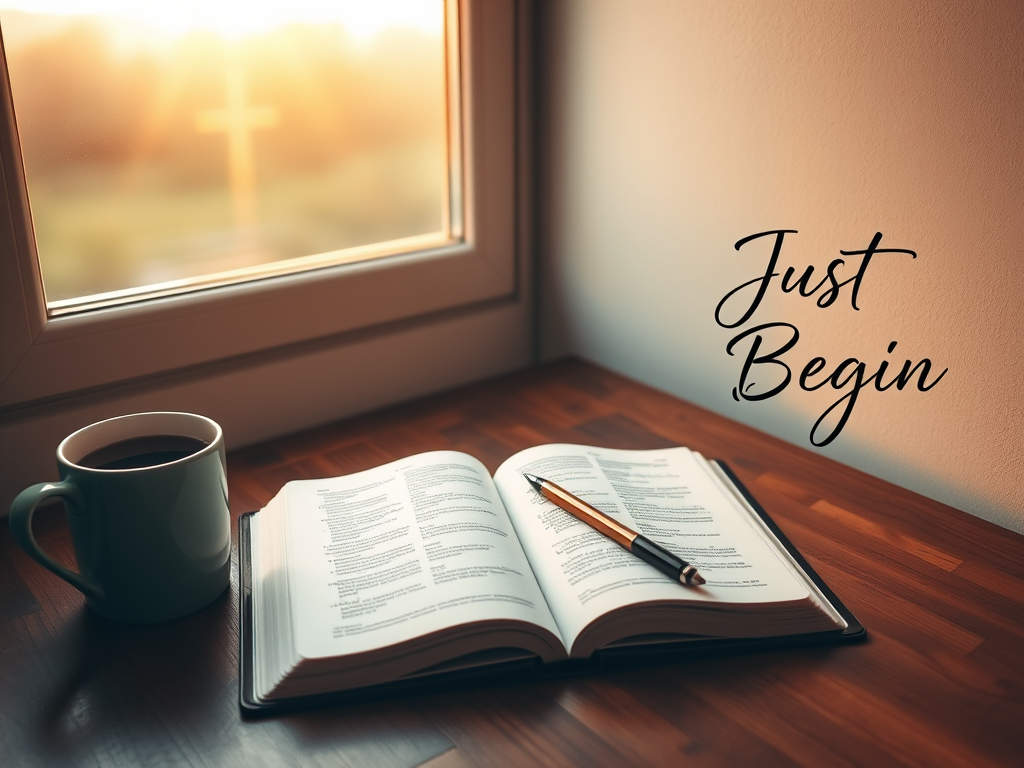
Just begin.
When I catch myself avoiding something, I do not try to convince myself to finish the whole project.
I tell myself to just begin.
Open the document.
Make the phone call.
Write the first sentence.
Take the first step.
Sounds simple enough.
And yet, there are still times when I have to push myself to take that first step.
Why?
Because replacing a habit takes time.
The new behavior has to be practiced until it begins to become more automatic than the old one.
That is where consistency matters.
This Week’s Micro-Habit
Choose one habit you would like to change.
But instead of concentrating only on stopping it, ask yourself:
What will I do instead?
If you tend to procrastinate, replace “I’ll do it later” with Just begin.
If you automatically reach for your phone when you have a quiet moment, perhaps replace five minutes of scrolling with five minutes of prayer, reading or stillness.
If your first response to frustration is complaining, practice naming one thing you are grateful for instead.
If you tend to criticize yourself after a mistake, replace the criticism with a truthful question:
What can I learn from this?
The replacement does not have to be complicated.
In fact, simple is usually better.
What matters is repetition.
Practice the new behavior often enough that eventually it becomes the path your mind recognizes first.
Reflection
What habit have you repeatedly tried to stop without deciding what should replace it?
What healthy behavior could occupy that same space?
And what would happen if, instead of fighting the old habit every day, you began practicing the new one?
Breaking a habit is difficult.
Building a replacement takes patience.
But over time, what once required effort can begin to feel natural.
After all, that is how the old habit got there in the first place.
Don’t just remove the habit. Replace it.
Then practice the replacement until the new way becomes your new autopilot.
Walking in purpose, thinking in synergy. AI assisted.
When you really stop and think about it, the human body is amazing. Every single moment of every day, there are automatic processes happening inside of us that keep us living and breathing.
Most of the time, we do not even have to think about it.
God designed us with incredible internal systems that help us survive. But sometimes, those automatic responses can also get us into trouble—especially when it comes to anger.
You know the feeling.
That quick burst of irritation. That flash of indignation. That sudden urge to defend yourself, lash out, say the thing, send the text, make the call or prove your point.
In that moment, the reaction feels justified.
But just because a reaction is automatic does not mean it is wise.
Maybe that is why James tells us:
“Everyone should be quick to listen, slow to speak and slow to become angry.” — James 1:19
There is wisdom in that order.
Quick to listen. Slow to speak. Slow to anger.
Not quick to defend. Not quick to accuse. Not quick to respond out of hurt, pride or frustration.
Slow.
That word matters.
Because sometimes our brains react faster than our spirit has time to discern.
We feel something, and immediately we want to act on it. We want to answer back. We want to correct the record. We want to make sure the other person knows how wrong they are, how hurt we are or how unfair the situation feels.
But emotion moves quickly.
Wisdom usually takes a little longer.
That is why we have to learn to delay the reaction.
To slow our roll.
Delaying the reaction does not mean ignoring what happened. It does not mean pretending we are not upset. It does not mean allowing someone to mistreat us or avoiding a hard conversation that needs to happen.
It simply means we refuse to let the first wave of emotion make the decision.
We give ourselves a moment.
A breath. A pause. A prayer.
We allow truth to rise above the initial rush of feeling.
Sometimes, after a pause, we realize the situation was not as big as it felt in the moment. Sometimes we recognize that our pride was louder than our wisdom. Sometimes we discover that our response would have created more damage than the original offense.
And sometimes, the pause simply helps us respond with more grace.
That is the gift of slowing down.
It creates space between what we feel and what we do.
I have learned that my first reaction may be honest, but that does not always mean it is holy, helpful or wise.
So when anger rises, I am learning to ask:
Do I need to respond right now? Or do I need to give wisdom time to catch up?
Because once words are spoken, sent or posted, they cannot be unsaid.
A delayed response can protect a relationship. A delayed response can prevent regret. A delayed response can make room for the Holy Spirit to lead instead of letting pride take over.
There is strength in restraint.
There is maturity in the pause.
And there is wisdom in knowing that not every feeling deserves an immediate response.
This Week’s Micro-Habit
When you feel that quick burst of anger, offense or indignation, pause before you respond.
Do not send the text yet. Do not answer the email yet. Do not make the phone call yet. Do not say the thing your emotions are pushing you to say.
Take a breath and ask:
Is this response coming from wisdom, or from the wound of the moment?
Then give yourself time to answer honestly.
Reflection
Where in your life do you tend to react too quickly?
What would change if you gave yourself permission to pause before responding?
Sometimes the most powerful response is not the fastest one.
Sometimes the wisest thing you can do is simply slow your roll.
Walking in purpose, thinking in synergy. AI assisted.
When someone says something, does something, criticizes something, or corrects something—and suddenly your whole body wants to respond?
You want to lash out. You want to defend yourself. You want to prove a point. You may even want to make them pay.
It is not our finest moment.
But it is a very human one.
One thing I have learned over time is that my first emotional reaction is not always trustworthy. It may be honest in the sense that it reveals what I feel, but that does not mean it is wise. Feelings are real, but they are not always reliable decision-makers.
So I have had to learn to pause before I react, respond, or take action.
I have had to learn to analyze my gut reaction before I let it speak for me.
When Ego Answers First
Through that process, I discovered something uncomfortable.
Most often, when I was deeply offended, it was my ego responding—not my intellect, not my heart, and not the Spirit of God within me.
It was pride.
And pride is powerful.
Pride can take correction and hear rejection. Pride can take advice and hear insult. Pride can take a simple suggestion and turn it into a personal attack.
I used to be easily offended. At least, that is how it seems to me now when I look back.
I remember once, as a young wife, my husband tried to instruct me on how to properly clean our bathroom.
Well, let’s just say I was more than happy to let him clean it.
My attitude was, “If you can do it better, then you can do it yourself.”
At the time, I felt justified. I felt criticized. I felt like he was saying I was not good enough, not capable enough, not doing it right.
But looking back, I can see that my reaction had less to do with the bathroom and more to do with my own insecurity.
I did not handle critique or correction well from anyone. I considered it criticism. I took it as evidence that something was wrong with me, rather than recognizing that the other person might simply be trying to help.
That is what pride does.
It turns help into hurt.
Easily Offended
My faith eventually led me to a deeper question:
If I am secure in who I am in Christ, why am I so easily offended?
That question changed something in me.
Because if my identity is rooted in God’s truth, then every correction does not have to become a crisis. Every suggestion does not have to become an insult. Every disagreement does not have to become a battle.
Scripture tells us:
“Everyone should be quick to listen, slow to speak and slow to become angry.” — James 1:19
There is wisdom in that order.
Quick to listen. Slow to speak. Slow to become angry.
Not because anger is never real. Not because hurt does not matter. But because anger moves fast, and wisdom often requires a pause.
That pause gives us room to ask a better question.
Not just, “What did they do?” But, “Why did this upset me so much?”
Ask the Why
That has become one of the most helpful questions in my life:
Why did this upset me?
Not why were they wrong. Not why do they need to apologize. Not why am I justified in feeling this way.
But why did this touch such a tender place in me?
When I started asking that question honestly, I often found ego sitting underneath the emotion.
Pride. Insecurity. Fear of being wrong. Fear of not being respected. Fear of being seen as flawed.
That awareness did not excuse the other person if they were unkind. But it did help me separate the actual offense from the perceived injury.
And sometimes, what I was reacting to was more perception than truth.
That is where renewing the mind becomes so important.
Romans 12:2 tells us to be transformed by the renewing of our minds. That means we do not have to keep thinking the same way, reacting the same way, or interpreting every correction through old wounds and old insecurities.
We can let truth retrain our response.
Emotion Is Not the Best Decision-Maker
Emotion gives us information, but it should not always get authority.
Anger may tell us that something feels wrong. Hurt may tell us that something touched a sensitive place. Frustration may tell us that something needs attention.
But emotion alone does not make good decisions.
Emotion wants immediacy. Wisdom asks for clarity.
Emotion wants to win the moment. Wisdom wants to protect the relationship.
Emotion wants revenge. Wisdom seeks reconciliation and restoration.
When we react from emotion, we often create more damage than the original situation required. We say things we cannot take back. We assign motives that may not be true. We punish people for wounds they may not have caused.
But when we pause, we create space for a more humane response.
We can reframe the injury—or the perceived injury—without letting emotion control the outcome.
That does not mean we ignore hurt. It does not mean we avoid hard conversations. It does not mean we let people mistreat us.
It means we do not let pride drive the response.
This Week’s Micro-Habit
When you feel offended, angry, criticized, or corrected, pause before responding.
Ask yourself:
Is this my wisdom responding—or my ego?
Then ask:
Why did this upset me?
Am I reacting to what was actually said, or what I believe it meant?
Did this person intend harm, or did I interpret it that way?
What would a secure response look like?
How can I respond in a way that moves toward truth, reconciliation, or restoration?
That small pause can change everything.
It keeps emotion from making the decision before wisdom has a chance to speak.
Reflection
Where are you most easily offended?
Is there a place in your life where correction feels like criticism because it touches insecurity?
What would change if you responded from who you are in Christ, rather than from the wound of the moment?
Being slow to anger is not weakness.
It is discipline.
It is humility.
It is the fruit of a renewed mind.
Sometimes the most powerful thing we can do is pause long enough to let pride settle, truth rise, and grace lead the response.
There is a difference between what is urgent and what is important.
I know that in theory. Living it out is another matter.
My days are often interrupted by things other people consider urgent. Someone needs an answer immediately. A phone call needs to be made. An email is waiting for a response. A question comes up that apparently cannot wait another minute.
These things may be legitimate. They may need my attention eventually.
But do they need it right now—in the middle of something important that I am already doing?
That is the question I am learning to ask.
Urgent things are loud. They ring, buzz, flash and announce themselves. Important things are often much quieter. They wait patiently for us to make room for them.
The important work may be planning for the future, completing a major project, spending time with someone we love, caring for ourselves or sitting quietly with God. None of those things usually demand our attention with the same intensity as an incoming phone call or a new message.
But they may matter far more.
When Distraction Looks Productive
One of the most deceptive things about distraction is that it does not always look like wasted time.
Sometimes distraction looks productive.
Answering emails is productive. Returning calls is productive. Solving someone else’s immediate problem is productive. We can end the day exhausted, having completed dozens of small tasks, and still avoid the one thing that truly needed our focused attention.
That is why distractions can become such an effective form of procrastination.
We can stay busy without making meaningful progress.
Sometimes I wonder whether I am truly responding to a need—or simply using that need to avoid something more difficult. Important work often requires concentration, decisions, creativity or courage. It may feel easier to handle five small requests than to remain focused on the one significant task in front of me.
The distraction gives me an escape, while still allowing me to feel useful.
Distracted by Many Things
The story of Mary and Martha offers a powerful picture of this struggle.
Martha was busy serving. She was not doing something wrong or meaningless. She was taking care of real responsibilities. Yet Jesus told her that she was worried and distracted by many things, while Mary had chosen what was needed most.
That distinction matters.
Jesus did not say that responsibility was unimportant. He revealed that good and necessary activities can still pull us away from what matters most in a particular moment.
We can be distracted by perfectly reasonable things.
We can be busy doing good work and still miss the better thing.
That is especially important in our relationship with God. There will always be something else to do. Another task, another request, another problem and another notification will always be waiting.
Time with God rarely forces its way into our schedule.
We must choose it.
Name What Is Happening
The micro-habit is simple:
Name the distraction.
When something interrupts you, pause before automatically shifting your attention.
Say to yourself:
This is a distraction.
That does not mean the matter is unimportant. It does not mean you will ignore it. Naming it simply allows you to see clearly what is happening.
Something has entered your day and is asking you to abandon the priority you previously chose.
Once you name it, you can decide what to do with it instead of reacting automatically.
Ask:
Is this truly urgent?
Is it important?
Does it require my attention right now?
Can it wait until I finish what I am doing?
Am I responding responsibly—or escaping my priority?
That small pause returns the decision to you.
Choose Your Three Priorities
I use a desk pad that lists my projects and tasks, but it also gives me space to identify my top three priorities for each week.
Numbers one, two and three.
That simple practice helps me separate what needs to be done from what most needs to be done.
There may be twenty legitimate tasks on my list, but not all twenty deserve equal attention. Choosing three priorities gives the week direction. It reminds me what I decided was important before the noise began.
When an interruption comes, I can look at those three priorities and ask whether the new request truly outranks them.
Sometimes it does.
Real emergencies happen. People sometimes need immediate help. Plans must occasionally change.
But many interruptions are not emergencies. They are simply someone else’s preferred timetable.
That does not automatically make them my highest priority.
Protect What Matters
Important work requires protection.
Your health needs protected time. Your family needs protected time. Your business needs protected time. Your calling needs protected time. Your relationship with God needs protected time.
Without intention, urgent matters will consume every available space.
And yet it is amazing how much can be accomplished in a short amount of focused time when distractions are removed. An hour of concentrated effort can sometimes achieve more than an entire day of fractured attention.
Focus allows us to be fully present.
It helps us work with purpose instead of simply reacting to whatever appears next.
Naming the distraction is not about becoming unavailable or uncaring. It is about becoming a wiser steward of our attention.
Because attention is part of our time—and our time is part of our life.
This Week’s Micro-Habit
At the beginning of the week, write down your three most important priorities.
Then, whenever something interrupts one of them, pause and name what is happening:
“This is asking me to leave something important.”
Decide whether the interruption truly needs immediate attention. When it does not, write it down and return to your priority.
You are not refusing to do it.
You are choosing when to do it.
Reflection
What important part of your life is being repeatedly displaced by things that merely feel urgent?
Are your daily activities moving you toward what matters most—or simply keeping you busy?
Not everything demanding your attention deserves it immediately.
Sometimes the first step toward a more purposeful life is simply learning to say:
That is a distraction. I will come back to it later.
A person stands quietly on a dock overlooking a misty lake at sunrise
There are moments in life when the hardest part is not making the decision… it’s trusting it afterward.
I have learned something about myself over the years. When I am faced with difficult decisions, competing voices, or uncertain outcomes, I lean toward the option that brings peace to my soul.
Not necessarily the easiest choice. Not always the safest choice. And certainly not the one that gives me the illusion of total control.
Peace.
Because God is a God of peace, not chaos.
“For God is not the author of confusion, but of peace…” — Bible (1 Corinthians 14:33)
That verse has become more than scripture to me—it has become a filter.
Life has a way of making us believe that urgency equals wisdom. That if we think hard enough, analyze long enough, or wrestle enough, we can control the outcome.
But often, all that noise only creates more noise.
And somewhere in the middle of it, peace quietly waits.
Not loud. Not forceful. Just steady.
I have noticed that when I move against peace, I usually move into striving. Into fear. Into overthinking. I begin trying to predict outcomes, protect myself from disappointment, or convince myself that I know what is best.
That is where trust becomes difficult.
Because it is one thing to pray, “God’s will be done.” It is another thing entirely to mean it when His will may not match our preferred outcome.
Sometimes I wrestle with that.
I think most of us do.
We want God’s guidance… as long as it aligns with our expectations. We say we trust Him, but internally we are still negotiating with the future.
Yet true peace requires surrender.
Not passive surrender. Not giving up. But releasing the belief that we alone can see the full picture.
Sometimes the micro-habit is simply this:
Pause long enough to notice which thought carries peace.
Not comfort. Not avoidance. Peace.
Because comfort often keeps us stuck. Peace moves us forward.
One thought produces anxiety, striving, and mental chaos. Another produces clarity—even if the path ahead still feels uncertain.
That difference matters.
The older I get, the more I realize peace is not weakness. It is direction.
And maybe faith is less about knowing the outcome… and more about trusting the One who does.
✨ This Week’s Micro-Habit
When faced with a difficult decision, pause and ask yourself:
👉 Which option brings peace to my spirit?
Then sit quietly long enough to recognize the difference between peace and fear disguised as logic.
✨ Reflection
Are you asking God to guide your steps… or asking Him to approve the outcome you already chose?
“What the human being is best at doing is interpreting all new information so that their prior conclusions remain intact.” — Warren Buffett
It’s a striking thought.
We like to believe we are logical. Thoughtful. Open-minded. Truth-seeking. But in reality, much of what we do is something else entirely—we protect what we already believe.
Our minds don’t naturally search for truth. They search for agreement.
We filter new information through old conclusions. We accept what aligns and quietly dismiss what doesn’t. Not out of malice… but out of comfort. It feels safer to be right than to be changed.
And then there’s the heart.
“The heart is deceitful above all things and beyond cure. Who can understand it?” — Bible (Jeremiah 17:9)
That verse can feel harsh at first glance. But maybe it’s not meant to condemn us—maybe it’s meant to wake us up.
Because the heart doesn’t just feel… it convinces. It justifies. It tells stories that make our current beliefs feel true, even when they may not be.
So now we have both working together— a heart that persuades, and a mind that defends.
Left unchecked, that combination doesn’t lead us toward truth. It leads us deeper into ourselves.
Which is why this instruction becomes so powerful:
“Be transformed by the renewing of your mind.” — Bible (Romans 12:2)
Transformation doesn’t happen automatically. It requires intention.
It requires us to pause in the middle of our certainty and ask: What if I’m wrong? What if there’s more to see?
Renewing the mind means creating space between what we feel and what is true. It means inviting God into our thinking—not just our believing.
Because truth doesn’t always feel comfortable. And growth rarely feels familiar.
But there is something deeply freeing about surrendering the need to be right… and choosing instead to be transformed.
Today is an opportunity.
To notice your thoughts. To question your assumptions. To soften your certainty just enough to let truth in.
Not everything we think is truth. Not everything we feel is right.
But with a renewed mind, we can begin to see more clearly.
And that changes everything.
✨ Reflection
Where in your life might you be holding onto a belief simply because it feels comfortable?
For a long time, I told myself that I did my best work under pressure.
It sounded responsible. It sounded productive. It even sounded a little impressive.
But if I’m honest, most of the time it was just a spiritual-sounding way of saying:
“I’m procrastinating.”
Not because I didn’t care. Not because I was lazy. But because some parts of my work simply weren’t as fun, as stimulating, or as energizing as others.
Every vocation—even the ones we love—has responsibilities like that.
Paperwork. Follow-ups. Planning. Administrative details. Hard conversations. Uncomfortable decisions.
Those were the areas where I delayed.
I waited for motivation. I waited for the right mood. I waited for “more time.”
And usually… all the time I was procrastinating, I was also feeling the pressure and the stress and the weight of unfinished business.
When Pressure Becomes an Excuse
Somewhere along the way, I noticed a pattern.
I would delay a task until the deadline was close. Then I would rush, scramble, and stress. And when I finished, I would say,
“See? I work best under pressure.”
But the truth was:
Pressure didn’t make me better. It just made me tired.
It didn’t improve my work. It only increased my anxiety.
And it certainly didn’t honor the peace God desires for His children.
The Two Words That Changed Everything
Then I learned a simple phrase.
Just two words.
Two words that quietly transformed my productivity, my mindset, and my peace.
Just begin.
That’s it.
Not “finish it all.” Not “do it perfectly.” Not “feel inspired first.”
Just begin.
Why “Just Begin” Works
When you begin something, something powerful happens.
Fear loses its voice. Overwhelm starts to shrink. Confusion begins to clear. Momentum starts to grow.
Motivation doesn’t usually come before action.
It comes after.
We think we need to feel ready.
But readiness is often the result of obedience.
When you take the first small step, God meets you there.
How I Practice This Micro-Habit
Now, when I notice myself avoiding a task, I pause and ask:
“Why am I delaying this?”
And then I say out loud:
“Just begin.”
Sometimes that looks like:
Opening the email and typing one sentence
Filling out one line of paperwork
Writing one paragraph
Making one phone call
Creating one outline point
I often set a five-minute timer.
Five minutes feels manageable. Five minutes feels safe. Five minutes feels possible.
And more often than not, five minutes turns into thirty.
Because once you start, you’re no longer fighting resistance.
You’re moving forward.
Procrastination Is Often Fear in Disguise
Over time, I realized that procrastination isn’t usually about time.
It’s about emotion.
Fear of doing it wrong. Fear of it taking too long. Fear of not knowing where to start. Fear of feeling inadequate.
So we delay.
We distract ourselves. We reorganize. We “get ready.”
But rarely do we begin.
“Just begin” interrupts that cycle.
It replaces fear with faith.
A Spiritual Perspective
There is something deeply spiritual about starting.
Scripture tells us:
“The steps of a good person are ordered by the Lord.”
Notice it says steps.
Not sitting. Not waiting. Not overthinking.
Steps.
God orders movement.
When we begin, we are saying:
“Lord, I trust You with this process.”
“I trust You to guide me as I go.”
“I trust You to meet me in the middle.”
Faith is rarely about having everything figured out.
It’s about taking the next right step.
Small Starts Lead to Big Faithfulness
Some of the most meaningful progress in my life has come from very small beginnings.
One email. One decision. One page. One prayer. One phone call.
Over time, those small beginnings add up.
They build discipline. They build confidence. They build integrity.
And they create peace.
Because there is great freedom in knowing:
“I did what I was supposed to do today.”
My Invitation to You
If there is something you’ve been delaying…
A project. A conversation. A decision. A responsibility.
I invite you to try this with me.
Right now.
Don’t finish it. Don’t perfect it. Don’t overthink it.
Just begin.
Take one small step.
And trust God with the rest.
Final Thought
You don’t need more motivation. You don’t need more time. You don’t need perfect conditions.
I get asked a lot how I manage to get so much done.
The short answer? I don’t let things linger.
In my last post, I shared how starting each morning by checking my calendar sets my intention for the day. That one minute grounds me in what actually matters.
The next micro habit builds on that foundation:
Deal with things as they come across your desk.
Not later. Not “when I have time.” When they arrive.
Why This Matters
Every unopened email, unanswered text, or unopened envelope quietly takes up mental space. Even when we’re not actively thinking about it, our brain knows it’s there—and that low-grade tension adds up.
This habit isn’t about being reactive. It’s about being decisive.
Email: Touch It Once (If Possible)
I check my email once a day, usually mid-morning. Anything that comes in after that waits until the next day—unless I’m expecting something specific.
When I open an email, I make a decision immediately:
If it’s an invitation to a meeting or webinar I register or reply right then and post it to my calendar. I don’t save it for later.
If it requires information I don’t yet have I use Gmail’s Boomerang feature and schedule it to return to my inbox at a time when I know I’ll have what I need.
No mental notes. No sticky reminders. No inbox clutter pretending to be a to-do list.
Snail Mail: Same Rules Apply
Physical mail gets the same treatment:
Read it.
Toss it.
Answer it.
If it’s a bill that requires payment, I don’t stop my workflow to pay it immediately—but I do decide what to do with it.
I pay bills twice a month: the 15th and the end of the month. Anything due goes into a designated file until that time. Once it’s filed, my mind is free from it.
The key isn’t doing everything instantly. The key is deciding instantly.
Text Messages: The Fastest Path to Me
Text messages are actually the easiest—and often the best—way to reach me.
If I see it, I answer it. No inbox triage. No delay.
That responsiveness isn’t accidental; it’s the byproduct of not letting communication pile up elsewhere.
The Real Secret Isn’t Speed—It’s Closure
This micro habit works because it creates closure.
Every message, email, or envelope asks one simple question: “What am I going to do with this?”
When you answer that question immediately, you remove friction from your day and clarity replaces clutter.
It’s a small habit. But repeated daily, it quietly multiplies your effectiveness.
We all like to think of ourselves as the “good ones.” Kind-hearted. Well-intentioned. Fair. Reasonable. Doing the best we can.
And most of the time, that’s true. But there’s another truth we don’t always like to examine: we all have blind spots about ourselves. Those behaviors, motivations, or attitudes that we simply cannot see clearly because we’re standing too close. Because we have told ourselves that our actions are pure.
It’s a strange thing—the way the human mind works. We are both the main character in our lives and the most deceitful interpretor.
The Version of Ourselves We SEE… and the Version Others EXPERIENCE
If you’ve ever replayed a conversation in your head and thought, “I didn’t mean it that way,” you’ve already brushed up against the idea of blind spots. Sometimes it is a matter of clarity – we know what we meant but failed to explain it adequately. Other times, we justify our actions or our words because we haven’t truthfully examined our own motive.
Intent is internal. Impact is external.
We tend to judge ourselves by our intentions, but others judge us by our actions. And somewhere inside that gap is where misunderstandings, missteps, and sometimes hurt feelings take root. Not because we’re bad people. But because we didn’t look deeply enough.
We saw ourselves in our best light—the most generous interpretation and the most gracious version of the ideal motive.
Meanwhile, someone else may have experienced something entirely different.
Our Inner “Best Light” Filter
There’s a built-in psychological trick humans play on themselves: we assume we’re acting for the right reasons because we want to believe we’re good. We filter our own motives through the lens of what we hope they are— not always what they actually are. And we really need to look deeply to discover our true motives and intentions.
“I’m just being honest.” → But is it honesty, or is it impatience?
“I’m only trying to help.” → Or are you trying to control the outcome?
“I’m standing my ground.” → Or are you avoiding vulnerability?
“I’m doing what’s best for them.” → Or is it what’s safest for you?
Most of the time, it’s a blend and it’s complicated. We can have pure intentions tangled up with ego, fear, habit, and pride.
‘Unto the Pure, All Things Are Pure’ — But… Are We Pure?
This scripture has a beautiful simplicity. If your heart is honest, you’re not looking for deceit. If your motives are clean, you aren’t plotting harm. If your spirit is aligned, you see the world through that clarity.
But this verse doesn’t assume perfection. It’s an invitation to examine: Are we truly operating out of purity… or out of something else?
Purity is clarity. Purity is self-awareness. Purity is the willingness to see ourselves without the flattering filters.
It doesn’t mean we’re flawless. It means we’re willing to look. And willing to admit our imperfections and to change, or pivot as necessary.
Why Blind Spots Matter
Blind spots aren’t inherently bad. They’re human. But when we don’t acknowledge they exist, they affect our relationships, and our ability to lead. They affect our intent and the outcome of our actions.
And often, they keep us from growing because we can’t heal what we won’t see.
Three Practical Ways to Reveal Your Blind Spots
1. Ask yourself the uncomfortable “why.” Twice.
Once you think you know your motive, ask again. The second answer is usually closer to the truth.
2. Seek perspective gently, from people who love you enough to be honest
People who want the best for you. You don’t have to agree with everything they say, but their vantage point matters.
3. Rethink your interpretation of your own behavior.
Before justifying something you did or said, pause. Is the story you’re telling yourself the whole story… or just the comfortable part?
The Good News: Blind Spots Shrink with Self-Reflection
Seeing ourselves clearly isn’t a one-time thing. It’s a practice—a spiritual and emotional discipline that gets easier the more we do it.
When we’re willing to step back, invite clarity, and examine our motives with honesty, we move closer to that scripture:
Unto the pure, all things are pure.
Not because we’re perfect, but because we’re continually choosing truth over comfort, humility over ego, and growth over self-protection.
And when we do that, not only do we see ourselves more clearly— others begin to see us through that clarity as well.